Die Rapanui Sprache von der Osterinsel
Rapanui – die geschichtliche Entwicklung einer fast
verloren gegangenen Sprache
  Kurzbeschreibung: Kurzbeschreibung:
"Rapanui" ist ein von den Bewohnern der Osterinsel
benutzter polynesischer Dialekt aus der austronesischen Sprachfamilie.
Die Sprache ist aber aufgrund der langen Isolierung von den übrigen
polynesischen Inseln eine eigenständige Sprache. Die Bewohner
der Osterinsel nennen sich ebenfalls Rapanui, die Insel "Rapa
Nui".
Rapanui ist verwandt mit den Untergruppen der Sprachen aus Tahiti,
Marquesas, Hawaii oder Maori. Viele der heute vorhandenen Wörter
stammen aus dem Tahitianischen. Einige Forscher meinen, dass die
Rongorongo Schrift eine frühe Form des Rapanui ist. Heute
wird Rapanui aber in lateinischer Schrift geschrieben. Die Sprache
umfasst 5 Vokale (a, e, i, o, u) und 10 Konsonanten (h, k, m,
n, ng, p, r, t, v).
Quelle:
- "Der wohlversuchte Süd-Länder",Carl-Friedrich
Behrens, S. 78 ff., 1738,
- "The Voyage of Captain Don Felipe González to Easter
Island, 1770–1"
- "Eine Reise gegen den Südpol und rund um die Welt,
Band 1 aus dem Jahr 1777 von James Cook"
- "Brief an die Kongregation der heiligen Herzen Jesu und
Maria vom Dezember 1864", Bericht Eyraud an die SS-CC
- "Notizen über die Bräuche und Traditionen der
Rapanui", Hippolyte Roussel 1866 bis 1869,
veröffentlich Rapa Nui Journal (PDF), übersetzt
von Ann M. Altman, Oktober 2003
- "Early Visitors to Easter Island 1864-1877", Ann M.
Altman, S. 37 - 62
- "Die Oster Insel - Eine Stätte prähistorischer
Kultur in der Südsee 1883",
Bericht des Kommandanten, Kapitänleutnant
Wilhelm Geiseler vom 2. November 1882.
- "Die Osterinsel", Walter Knoche 1925
Die Rapanui Sprache von
der Osterinsel
Als die Entdecker um Jacob
Roggeveen 1722 erstmalig die Osterinsel betraten, sprachen
die Insulaner eine Sprache, die sich heute "Rapanui"
nennt. Sie kommt aus dem polynesischen Raum und ist
verwandt mit den Sprachen von Tahiti, den Marquesas, Mâori
(also Neuseeland) und Hawaii. Die Sprache ist aufgrund der langen
Isolierung von den übrigen polynesischen Inseln eine eigenständige
Sprache.
Wort und Schrift:
Eine Wortschrift im klassischen Sinn gab es
bis zur Ankunft der Missionare nicht. Die frühen Osterinsulaner
hatten aber mit "Rongorongo"
Symbole entwickelt, mit denen sie bis zu 600 unterschiedliche
Symbolenzeichen kombinieren konnten. Bei Rongorongo handelte
es sich allerdings mehr um Gedächtnissymbole zum Auswendiglernen
von religiösen Hymnen. Bei den Hymnen ging es vornehmlich
um die Wiedergabe von Legenden und weniger um Aufzeichnung und
Wiedergabe von Kulturwissen.
Mit Ankunft der Missionare im März 1866 wurde versucht,
den Insulanern ihre Sprache als Schrift in lateinischen Buchstaben
zu vermitteln. Dies gestaltete sich als sehr schwer, weil sich
die Bevölkerungszahl durch die gewaltsamen Entführungen
in den Jahren 1862/63 und Tod durch die anschließend eingeschleppten
Krankheiten bis 1866 bereits auf unter 1200 Individuen reduziert
hatte. Die ab 1866 immer noch durch Pocken oder Tuberkulose
verursachten Sterbefälle sowie Evakuierungen
und Vertreibungen in den Jahren 1871 und 1872 ließ die
Bevölkerungszahl bis 1877 auf letztlich
111 Menschen zusammenschmelzen. Zu dieser Zeit gab es
auf der Osterinsel, auf den Maquesas-Inseln und Tahiti zusammen
weniger als 500 Menschen, die überhaupt noch zur
Urbevölkerung gehörten.
Französisch:
Während der Anwesenheit der Missionare (1866 bis 1871)
wurde versucht, den Insulanern auch die französische
Sprache zu vermitteln. Die Missionare mit Bischofssitz Tahiti
sprachen französisch und Tahiti stand unter dem Einfluss
von Frankreich.
Tahitianisch:
Die Rapanui standen in dieser Zeit (also
zwischen 1872 bis 1888) zudem unter dem Einfluss der Tahitianischen
Sprache, weil sie einerseits stetigen Kontakt mit Landarbeitern
aus Tahiti hatten und andererseits sich die Sprache von aus
Tahiti zurückgeführten Rapanui bereits mit der Tahitianischen
Sprache vermischt hatte. So stammen heute viele der
gültigen Wörter aus dem Tahitianischen.
Chilenisch:
Der 1888 zwischen Policarpo
Toro und Chile abgeschlossene Pachtvertrag zur Ausbeutung
der Osterinsel gab vor, auch chilenische Familien auf der
Osterinsel anzusiedeln. Diese Ansiedlungsversuche scheiterten
jedoch schon nach einem Jahr. Die auf der Insel lebenden Rapanui
wollten mit den "Kontinentalen", wie sie abfällig
betitelt wurden, allerdings nichts zu tun haben. Auch mit
den ab 1897 eingeführten Festland-Chilenen, die die Tiere
der örtlichen Schaffarm vor den Rapanui schützen
sollten, wollten sich die Einheimischen nicht vermischen.
So blieb die Ursprache der Rapanui von den indigenen chilenischen
Sprachen verschont.
Spanisch:
Mit der Annektierung
der Osterinsel durch Chile im Jahre 1888 standen die Rapanui
plötzlich nicht mehr unter dem Einfluss von französisch
sprechenden, sondern unter spanisch sprechenden "Herren".
Von nun an gilt die chilenische Fahne als Hoheitszeichen und
in Chile wird Spanisch gesprochen. Der amtierende Sprecher
der Rapanui, Atamu
Tekena und der Sprecher der chilenischen Siedler, Pedro
Pablo Toro, vereinbaren noch im Jahr 1888, auf der Osterinsel
eine kleine Schule für Spanischunterricht anzubieten.
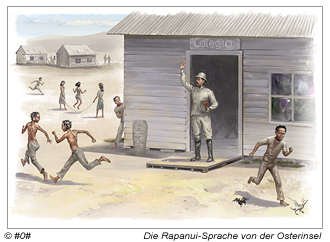
1897 wird die Rapanui-Fahne verboten, 1914 wird die erste
Zivilschule auf der Osterinsel installiert und fortan Spanisch
unterrichtet. Den Kindern wird verboten, ihre eigene Sprache
zu sprechen. Selbst mit den 1965 erlangten Freiheiten (Integration
der Rapanui als chilenische Staatsbürger, Reisefreiheit
und Mitspracherecht in den politischen Entscheidungen) bleibt
die indigene Sprache verboten. Die Amtssprache ist
bis heute spanisch.
Rapanui:
Der erste offizielle Rapanui-Unterricht wurde 1975 auf Anordnung
des chilenischen Erziehungsministeriums zugelassen. Doch schon
im Jahre 1980 brachte Chile dann ein Gesetz auf den Weg, dass
es den Rapanui verbot, ihre Muttersprache zu sprechen. Dieses
Gesetz wurde 1984 mit Fürsprache des damaligen chilenischen
Präsidenten Augusto Pinochet wieder aufgehoben und das
Schulsystem reformiert. Ab nun wurden sowohl die Rapanui-Sprache
als auch die lokale Folklore zu Pflichtfächern in der
Schule. Mit dem sogenannten "Indigenen-Gesetz" (Gesetz
Nr. 19.253) von 1993 gab es erstmals eine Vorschrift zum Schutz,
zur Förderung und zur Entwicklung der Kultur und Sprache
der Einheimischen.
Unabhängig von den von Chile zugelassenen Förderungsmaßnahmen
bemühen sich seit dem neuen Jahrtausend auch private
Musik-, Sport- und Heimatvereine um die Erhaltung der ursprünglichen
Sprache und die der traditionellen Kultur wie Tanz, Musik,
Kunst oder Sport.
Auf der Osterinsel, dem chilenischen Festland sowie auf Tahiti
und in den USA gibt es heute rund 3.500 Menschen, die Rapanui
sprechen.
Das erste überlieferte Wort:
Das erste überlieferte Wort der Rapanui
hat Carl-Friedrich
Behrens in seinem Buch "Der wohlversuchte Süd-Länder"
von 1738 veröffentlicht. Behrens beschreibt den Moment,
als der erste Inselbewohner am 07. April 1722 das Führungsschiff
der Roggeveen-Flotte wieder verlassen muss und dabei "O
dorroga! O dorroga!" ausruft. Der neuseeländische
Linguist Steven Roger Fischer meint, "O dorroga" leite
sich von "otoroka" ab und bedeutete so viel wie "Willkommen".
"O dorroga" bzw. "otoroka" findet sich heute
aber nicht mehr im Wortstamm der Rapanui. Andere überlieferte
Worte sind beispielsweise "Maca Maca" bzw. "Moày"
(Antonio de Agüera
1770).
Das erste kleine Wörterbuch:
Antonio de Agüera
war es auch, der im November 1770 das erste kleine Wörterbuch
aus 88 Wörtern zusammengestellt hat. Auffällig an
dieser Wortauflistung: Viele Wörter beginnen mit dem Konsonanten
"C". In der
heutigen Sprache fehlt dieser Konsonant aber
gänzlich.
| Name / Wort: |
in Rapanui: |
|
Name / Wort: |
in Rapanui: |
| Haare |
Coojo |
|
Luft |
Tetuba |
| Augenbrauen |
Geijio |
|
Wasser |
Canocona |
| Augen |
Comata |
|
Land |
Genua |
| Wimpern |
Coveque-veque |
|
Hügel |
Gemauma |
| Nasenlöcher |
Coiju |
|
Feuer |
Cotierpe |
| Mund |
Coaja |
|
Rauch |
Puina |
| Zunge |
Corero |
|
Himmel |
Gerani |
| Zähne |
Conijo |
|
Sonne |
Gera |
| Lippen |
Conuto |
|
Mond |
Magin |
| Wangen |
Cococumo |
|
Sterne |
Getu |
| Kinn |
Cocoba |
|
Das Meer |
Geray |
| Ohr |
Cotarina |
|
Hütte oder Wohnung |
Geveca |
| Bart |
Covere |
|
Kalebasse |
Geracona |
| Hals/Nacken |
Conao |
|
Speichel |
Coano |
| Kopf |
Coray |
|
Schleim |
Coupé |
| Gesäß |
Couju |
|
Waffen |
Corima |
| Muskeln |
Cotumo |
|
Hände |
Comangamanga |
| Knie |
Coturi |
|
Finger |
Comangamanga |
| Bein |
Gebae |
|
Nägel |
Comaicucu |
| Wade |
Coique |
|
Brust |
Couma |
| Ferse |
Coreque |
|
Nippel |
Coù |
| Fuß |
Magamaga |
|
Magen |
Coqueo |
| Mann |
Cotajata |
|
Bauch |
Cotino |
| junge Frau |
Cotataqui |
|
Rücken |
Cotuorbi |
| alte Frau |
Copocopoco |
|
Nabel |
Copito |
| Huhn |
Comoa |
|
Leiste |
Coputo |
| Banane |
Cocay |
|
Genitalien |
Gemaropao |
| Feigen |
Gecoy |
|
Kanu oder Schiff |
Gebaca |
| Steinidole |
Moày |
|
Priester des Idols |
Maca Maca |
| Götzenhülle |
Copeca |
|
Tanzen |
Viritejue |
| Idole mit bemalten Körpern |
Pare |
|
Musik |
Toro Toro Toro |
| Oberhäuptling oder Herr |
Tequeteque |
|
sich hinsetzen |
Canojo |
| eine gute oder schöne Sache |
Cariba |
|
Aufstehen |
Comaro |
| eine hässliche oder verächtliche Sache |
Macariba |
|
Spazieren |
Gejaere |
| still sein |
Comuou |
|
|
|
| jemanden abweisen |
Catajuti |
|
Ja |
E |
| Schwimmen |
Gecau |
|
Nein |
Ma |
| Küssen |
Cogimi |
|
Du |
Cocoa |
| Umarmen |
Cajai |
|
eins |
Coyana |
| Schlafen |
Geuru |
|
zwei |
Corena |
| Aufwachen |
Geura |
|
drei |
Cogojui |
| Zuschauen / Zuhören |
Arà |
|
vier |
Quiroqui |
| sich etwas wünschen |
Conoro |
|
fünf |
Majana |
| Ablehnen |
Maconoro |
|
sechs |
Feuto |
| Essen |
Cacay |
|
sieben |
Fegea |
| Streiten / Kämpfen |
Gecacai |
|
acht |
Moroqui |
| Trinken |
Cauno |
|
neun |
Vijoviri |
| |
|
|
zehn |
Queromata |
James Cook nennt
nach seinem Besuch im Jahre 1774 den Häuptling oder König
allerdings "Areeke" (ariki). Aus Cooks Reisebericht
weiß man auch, dass die Bevölkerung auf der Osterinsel
die gleichen Namensbezeichnungen für Zahlen benutzt haben,
die auch in Tahiti üblich waren.
Weitere Wortlisten:
Der nächste Forschungsreisende der eine kleine Liste von
Rapanui-Wörtern zusammenstellte war der Deutsche Wilhelm
Geiseler nach seinem Besuch im Jahre 1882. Der
US-Amerikaner William
J. Thomson hat sich während seines Aufenthaltes
im Jahre 1886 mit den Namen der Monate und der Tage im Mondkalender
beschäftigt. Außerdem gibt er in seiner Veröffentlichung
von 1891 Hinweise zum Dialekt, Aussprache und zu einzelnen Synonymen.
1911 folgt dann Dr.
Walter Knoche, der sich mit seinem Buch aus dem
Jahre 1925 zum Thema Linguistik und Grammatik ausläßt.
Hierbei meint Knoche, dass sich die Rapanui-Sprache 1911 bereits
stark verändert hätte. Danach würde der Wortschatz
der auf der Insel gesprochene Sprache bereits zu 30 % aus Tahitianisch,
10 % aus Spanisch oder Französisch und 5 % Englisch bestehen.
Das erste Lexikon:
Derjenige, der sich aber wirklich intensiv und vollständig
mit der Sprache der Rapanui beschäftigt hat war der Deutsche
Kapuziner Mönch Franz Anton Englert, besser bekannt als
Pater Sebastian
Englert. Englert war nach einer Einladung der Staatsuniversität
Chile im Jahre 1935 auf die Osterinsel gereist und hat in den
folgenden 15 Monaten dann ein vollständiges Werk über
die Sprache erstellt.
Die ersten Dolmetscher:
Die ersten Dolmetscher brachte James
Cook 1774 mit auf die Osterinsel. Es waren zwei junge Männer
aus Tahiti mit den Namen "Oedidee" und "Maheine".
Laut Cook konnte Oedidee vieles von dem verstehen, was die Osterinsulaner
sagten. Also ein deutliches Zeichen dafür, dass die Sprache
auf der Osterinsel dem Tahitianischen schon im 18. Jahrhundert
sehr ähnlich war.
Der nächste der einen Dolmetscher mit auf die Osterinsel
nehmen wollte, war der französische Novize Eugéne
Eyraud im Jahre 1864. Der Dolmetscher wurde "Daniel"
gerufen und kam aus Mangareva. Doch als Daniel am 02. Januar
1864 den Erstkontakt herstellen sollte und dabei auf ausgemergelte
kranke Menschen traf weigerte er sich, noch einmal an Land zu
gehen. Die Folge war: Es kam während Eyrauds neunmonatigem
Aufenthalt zu vielen Missverständnissen zwischen dem Missionarshelfer
und der Bevölkerung. Eyraud wurde zunächst von einem
Rapanui namens Torometi
komplett vereinnahmt bis dann ein Mopp des neu gewählten
Vogelmannes den Gottesmann bis auf die nackte Haut ausplünderte
und Eyraud evakuiert wurde.
Gerade einmal eineinhalb Jahre waren nach Eyrauds Evakuierung
vergangen, als er im März 1866 gemeinsam mit dem Missionar
Hippolyte Roussel
und gleich vier Helfern aus Mangareva zurück auf die Insel
kam. Es waren die Helfer "Araki" (Alaritio), "Akilio"
(Achille) und "Papetati" (Babilas), die u.a. auch
als Dolmetscher fungieren sollten, sowie "Pou Koki"
ein Mangaian-Koch. Der Preis den zwei der Mangarevaner hierfür
bezahlten war sehr hoch, denn Araki und Akilio starben im Oktober
1867 an Tuberkulose. Mithilfe seiner Helfer konnte Hippolyte
Roussel aber ein Rapanui Katechismus schreiben.
Schule:
1864: Die ersten Bemühungen, die Rapanui
zu unterrichten, startete der Novize Eugéne
Eyraud im Jahre 1864. Hier ging es vor allem darum, den
Einheimischen die Fähigkeit zum Lesen des Katechismus beizubringen.
In den neun Monaten seiner Anwesenheit auf der Insel hat er
es tatsächlich geschafft, dass fünf oder sechs Kinder
eine ausreichende Menge an Texten aus der Bibel lesen konnten.
1866 bis 1871: Wirklich gute Erfolge bei einem
schulischen Unterricht erreichten die Missionare Hippolyte Roussel
und Kaspar Zumbohm
während ihrer Missionsarbeit zwischen 1866 und 1871. Auch
hier ging es vornehmlich um das Erlernen von religiösen
Texten. Die Missionare hatten durch drei bereits geschulte Helfer
aus Mangareva eine wertvolle Hilfe. Bis 1868 brachte sich auch
der dann an Tuberkulose verstorbene Pater Eugéne Eyraud
als Lehrer für verschiedene Unterrichtsfächer ein.
1886: Der medizinische Offizier George H.
Cook von der Thomson-Expedition
(1886) berichtet: "Es gibt von den Priestern ein Schulhaus
von früher, in dem die Menschen aus Büchern in der
Rapanui-Sprache unterrichtet werden. Somit können die meisten
Eingeborenen lesen und schreiben. Die Aufgaben eines Pädagogen
werden in gewisser Weise von Pakomio
ausgeführt, dem Überlebenden der peruanischen Gefangenen,
der auch ein Prediger unter ihnen ist und die Gottesdienste
in der kleinen Kirche
leitet."
1888: Nach der Übergabe der Osterinsel
an Chile vereinbaren der Rapanui-Repräsentant Atamu
Tekena und der chilenische Siedler Pedro
Pablo Toro auf der Osterinsel eine kleine Schule für
Spanischunterricht anzubieten. Probleme zwischen den chilenischen
Siedlerfamilien und den Rapanui verhindern die Durchführung
eines derartigen Vorhabens. Die Rapanui bleiben lieber für
sich selbst.
1895 zieht der chilenische Lehrer Alberto
Sánchez Manterola mit seiner Familie auf die Osterinsel.
Seine Versuche, die Rapanui in Spanisch zu unterrichten dauern
allerdings nur 5 Monate, denn die auf der Insel verbliebenen
Einheimischen zeigen wenig Interesse an einen schulischen Unterricht.
Sánchez übernimmt im Auftrag des Viehzüchters
Merlet anschließend
die Verwaltung der Schaffarm.
1914 kommt der chilenische Journalist José
Ignacio Vives Solar auf die Osterinsel mit der Absicht,
eine Schule aufzubauen und Unterricht für die Kinder anzubieten.
Solars Vorhaben beruht auf einer Anregung des Deutschen Dr.
Walter Knoche, der die Möglichkeiten der Osterinsel
1911 im Auftrag der chilenischen Regierung untersucht und anschließend
entsprechende Empfehlungen an Chile ausgesprochen hatte.
Mit den von Vives
Solar mitgebrachten Baumaterialien kann das Gebäude
für die Schule relativ schnell fertig gestellt werden.
Es ist die erste Zivilschule auf der Osterinsel.

Zunächst kommen auch die Kinder zum Spanisch-Unterricht,
doch nach einigen Tagen haben die Kinder scheinbar das Interesse
verloren und kommen nicht mehr. Vives Solar meint, er sei kein
"Anwesenheitsbeamter" und so schläft das Schulprojekt
wieder ein. Nach einem Jahr gibt es keine Schule mehr. Vives
Solar nutzt das Gebäude für sein Amt als Insel-Gouverneur.
1915 nimmt Vives Solars Schwägerin die
Arbeit mit den Kindern wieder auf. Sie spricht spanisch und
zieht über den sonntäglichen Gottesdienst zwischen
40 und 50 Kinder zum Unterricht in eine Schule.
1917: Chile beschließt am 29. Januar
1917 per Gesetz (3220) unter anderem den Bau einer Schule. Das
Vorhaben wird nur zum Teil umgesetzt. Von dem geplanten Schulgebäude
wird lediglich eine Wand errichtet. Bei schlechter Witterung
fällt der Unterricht aus.
1934: Das Schulsystem der Osterinsel wird
der Verwaltung in Valparaíso unterstellt. Im Ortskern
von Hanga Roa wird ein
neues Schulgebäude errichtet. Es ist der Vorläufer
der heutigen Grundschule.
1936: Die Osterinsel wird unter der Oberaufsicht
der Handelsmarine gestellt. In diesem Zug werden die Rechte
der Rapanui durch ein Dekret des Verteidigungsministeriums verbessert.
Die Insulaner erhalten formal die gleichen Rechte wie die Festland-Chilenen.
Chile muss ab sofort für den Schulunterricht der Kinder
und für die Erhaltung der Familienstrukturen sorgen.
1963: Im November 1963 hat der Rapanui Alfonso
Rapu Haoa sein Pädagogikstudium beendet und wird vom
chilenischen Bildungsministerium als Lehrer der 3. Klasse auf
der Osterinsel verpflichtet und kehrt auf die Insel zurück.
Durch seine Position als Lehrer an der Schule und seinem gehobenen
Bildungsstand, wird "Alfonso Rapu Haoa" schnell ein
prominentes Mitglied in der Rapa
Nui Gemeinde und Sprecher einer sozialen Bewegung, die sich
für alle Angelegenheiten mit Konfliktpotential zwischen
der chilenischen Obrigkeit und den Rapanui einsetzen.
1976 wird ein Schulplan speziell für
die Osterinsel aufgestellt.
1980 erläßt Chile ein Gesetz, das
es den Rapanui fortan verbietet, ihre Muttersprache zu sprechen.
Zuwiderhandlungen werden mit Gefängnis bestraft. Das Verbot
wird 1984 wieder aufgehoben.

1984 wird das Schulsystem noch einmal reformiert.
Ab jetzt werden die Rapanui Sprache und lokale Folklore zu Pflichtfächern.
1987: Chile gibt die Schulverwaltung an die
Stadtverwaltung von Hanga
Roa ab.

|